

I’ve reviewed and torn down hundreds of LinkedIn ads over the past few years.
And the same patterns show up every time:
- They lead with features no one cares about
- They open with platitudes like “the #1 platform for…”
- They hide behind category language like “all-in-one,” “end-to-end,” or “AI-powered” — terms that don’t map to anything a buyer is actually dealing with
- They treat AI like a differentiator (it’s not — it’s table stakes, and if anything, it should be part of the reframe)
- They promote content without making the problem behind it clear
- They treat LinkedIn like a lead generator — something that should produce names — instead of a way to understand why someone might be worth talking to
On the surface, these ads look fine.
But they all miss the same thing.
Sales Doesn’t Need More Leads. It Needs Context and Relevance.
What sits underneath all of this is a set of assumptions about how LinkedIn is supposed to work that rarely get questioned, because they’ve been reinforced by years of lead generation thinking, platform defaults, and reporting structures that reward activity over understanding.
The idea is simple: if the targeting is precise enough, the creative is polished enough, and the offer is compelling enough, then the system will reliably produce a steady flow of leads that sales can convert.
This logic holds together on the surface, which is why teams continue to optimize within it.
It breaks down the moment those leads reach a salesperson who has no meaningful context for the outreach, no insight into what prompted the engagement, and no way to connect the initial click to a problem the buyer is actively trying to solve.
The result is not simply lower conversion rates or longer sales cycles, but a fundamental disconnect between what marketing is producing and what sales requires to initiate a conversation that feels relevant, timely, and worth responding to.
Attract People Who Recognize the Problem
Most B2B marketers are asking LinkedIn to do a job it was never meant to do.
LinkedIn is not an intent channel, and people don’t show up looking for solutions. If you want them to stop scrolling, your ad has to surface a problem they already recognize as their own.
Every interaction with an ad is a signal, not of interest in your product, but of alignment with a specific issue the buyer is experiencing. When that problem is clear, engagement becomes useful because it gives sales a starting point grounded in something the buyer has already acknowledged, and it shows them where to focus.
The best salespeople already work this way. They don’t chase every name. They concentrate on signals—on the people who have shown some indication that a problem exists.
Without that, a lead is little more than a name attached to an action. With it, there is context for the outreach, a reason for the engagement, and a way to connect the initial click to a conversation that feels relevant.
The Best Ads Start With a Problem You Recognize Immediately
Take this one from Similarweb.
“This is Jordan. He has no idea what his competitors are doing.”
You don’t need to know anything about Similarweb to understand it. If you’ve ever walked into a meeting unprepared, or felt exposed in front of your boss, the problem is clear.
That’s what stops the scroll.
.png?width=863&height=1125&name=Similarweb%20ad%20(1).png)
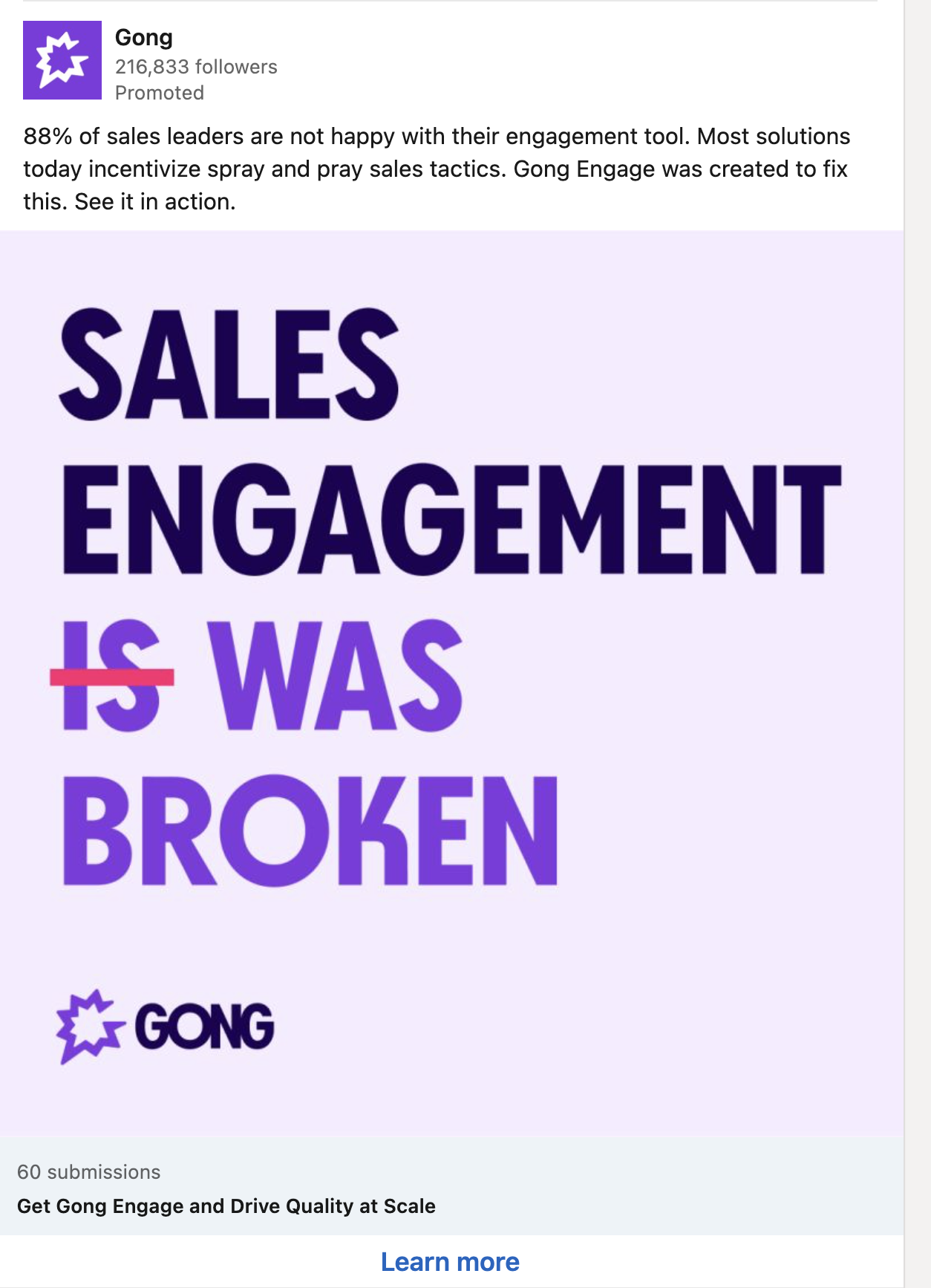
Gong takes a similar approach.
“88% of sales leaders are not happy with their engagement tool.”
The ad doesn’t begin with features or product claims. It starts with a frustration most sales leaders have already experienced—tools that encourage activity without improving outcomes.
If that problem feels familiar, the rest of the message has somewhere to land.
The Sweep ad is even more direct.
“2 months in… still can’t make a change without breaking something.”
Anyone who has worked inside Salesforce understands that immediately. The message reads like a text, but it reflects a real, specific frustration.
The product comes later. It’s the problem that carries the message.
.png?width=912&height=1312&name=Sweep%20ad%20(1).png)
And even though it's not a LinkedIn ad, I wanted to include this ad from Safelite:

It doesn’t try to sell anything. It simply puts you in the moment when you’ll need them.
These ads don’t rely on someone already looking for a solution.
They surface a problem the buyer recognizes, which is what gives the interaction meaning.
And when someone clicks, sales doesn’t have to guess.
The problem is already on the table.
On APRIL 2, join our LinkedIn Ads Roundtable: Using Ad Engagement to Identify Sales Opportunities
The session will take place on April 2 at 1:00 PM ET and will focus on how companies are interpreting engagement signals, connecting advertising activity to pipeline, and navigating the attribution challenges that often confuse these discussions.
Topics we’ll explore include:
- How teams are connecting LinkedIn ads to pipeline and revenue
- What engagement signals actually help sales prioritize accounts
- Why CEOs often question LinkedIn ad performance
- What attribution gets wrong about how deals really start
This will be a roundtable discussion rather than a webinar, so participants are welcome to share what they’re seeing in their own campaigns, ask questions, or simply listen to the conversation.
You can register here: https://bit.ly/3NjsYN9